|
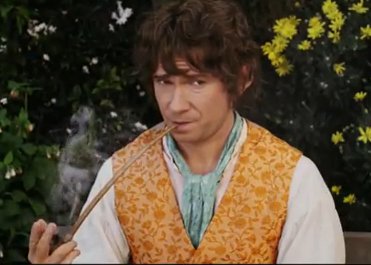
| The complete Hobbit cast. Okay, the 15 main protagonists. Okay, the 15 protagonists who go to reclaim Erebor. |
Bilbo
and Gandalf make their way home, stopping to visit those who had
taken them in on the way to the Lonley Mountain. If there were adventures (and we are
assured there were) we do not get to hear of them.
Finally
Bilbo arrives home to find his possessions being auctioned off as the
villagers think he's dead. He's upset to find his stuff being sold and has to buy most of it back. I'm not sure what this detail adds to the story or why it was included. It's a bit like John McClane stopping the terrorists and arriving home to find his house had been knocked down by an earthquake.
But
he's happy and content. Years later, Galdalf and Balin visit Bilbo while he's writing his memoirs and they tell him that all is well in the Lonely Mountain too.
“They
fell to talking of their times together, of course, and Bilbo asked
how things were going in the lands of the Mountain. It seemed they
were going very well. Bard had rebuilt the town in Dale and men had
gathered to him from the Lake and from South and West, and all the
valley had become tilled again and rich, and the desolation was now
filled with birds and blossoms in spring and fruit and feasting in
autumn. And Lake-town was refounded and was more prosperous than
ever, and much wealth went up and down the Running River; and there
was friendship in those parts between elves and dwarves and men.”
So
a happy ending for most.
Overall
the book is badly paced and far too limited in it's point of view.
Are we to assume the Narrator is Bilbo and this is why our
perspective is so limited? Perhaps, though it is never stated. If Bilbo is the narrator, it explains why we learned so little about the final battle after Bilbo is knocked out, it doesn't explain though, how Bilbo knew such detail about the dragon's attack on Lake-town, since he also wasn't there for it. If he asked for that information to include it in such detail in his memoirs, then why didn't he ask about what happened in the battle? Why gloss over the biggest fight in the whole book?
And what of our questers; we still know next to nothing about them. A few
lines of back story in a few cases, such as Thorin and Bilbo, but
overall not much at all. They seem like stereotypes, all behaving as
a dwarf, elf, hobbit etc. should, rather then becoming people in
their own right. Even Bilbo. All we know is that his mothers family
had an adventurous side, we learn very little of just how and why he
is brave and cowardly in equal measure, he simply is and we must
accept that.
The
characters are little more than caricatures and I am still none the
wiser as to their motivation on the whole.
I
would like someone to explain to me how Thorin dying made him a good
person. Many died that day and all his dying proves is that Thorin was
not a coward (unlike Bilbo). I still do not know who Thorin was, nor
any of the other dwarves. Even Bilbo; one might think he had
been changed by his adventures, however it seems that he is now perfectly
content to go back to the small, quiet little life that he had before.
I
must also note that we have made it through the entire book with only
two female characters even being mentioned in passing. Not an eagle, wolf,
hobbit, dwarf, goblin, elf or man having a single woman feature among their number. I
assume they exist since two have been mentioned but clearly they do
not merit an acknowledgement.
Actually
I'm glad for that.
JRR
Tolken was raised during the women's suffrage movement and after much
struggle, torture, imprisonment, assault and suffering, often for nothing more
than standing up and daring to ask when women would get the vote, they finally succeeded in 1928, nine years before this book was
written. He could not in any way shape or form have missed the
suffrage movement and the courage and sacrifice of it's members.
While writing these
blogs I have heard a lot of people excuse Tolken's weaknesses because he
wrote The Hobbit as a story for his children, not for commercial
success. Okay, fine, but he had a daughter born in 1929, making her 8
when this book was published. Did he write this story only for his sons?
If not, why didn't he want to include a role model for his daughter, or even just a single female character that she could relate to?
I tend to believe
that only the most
ardent of misogynists would completely ignore an entire gender and it seems obvious to me that JRR Tolken had no use for women, beyond being a
wife and mother. If you require more proof of this, the only two women mentioned were as mothers to the protagonists. One doesn't even merit a name, just sister of Thorin, mother of Fili and Kili. That poor nameless woman lost her brother and two sons in a single day!
Therefore I am glad that Tolkien chose to ignore women for had he included
them, they would surely be pale, meek and most likely little more than
slaves at worst or drudges at best. If that is to be our depiction,
then I would rather have no depiction at all.
The
great thing with fantasy is that anything is possible, even things
that need no explanation, so why do so many fantasy writers want to
ignore us or enslave us? In other words, go back to when we were
repressed rather than looking forward to the day when true equality or even superiority (it is fantasy, after all)
is possible?
This
has been an interesting experience and the book is mildly
entertaining, but I have no desire to ever read it again. I do have a
desire to learn more about these two dimensional characters, to know
why they act as they do, what their internal dialogue is, and I hope
that the movie will fill in some of those gaping holes. The two and a half minute
trailer certainly gives the characters more depth that this entire
book has done so that gives me hope.
Will
I watch the movie? Maybe. At least it can't be any
worse than the book!
 What's the up shot of this? If you want to help Thorin, Bilbo and company defeat Smaug the dragon, please leave me a review!