Showing posts with label history. Show all posts

Saturday, 23 November 2013

Some Important Female Scientists That You've Probably Never Heard Of


In my last post I discussed how and why Damaris's character was formed. In this one, I'll introduce you to a handful of the women scientists who helped me create the intellectual side of her. She is not based on any one person here and indeed, many have little in common with her, but are nevertheless worthy of being remembered for their contributions to science. 

 
Caroline Herschel came to England from German in 1772, to run her brother’s house for him. When her brother took an interest in Astronomy, Caroline followed and helped him make observations and build telescopes, becoming a renowned astronomer in her own right. She was the first woman to discover a comet and discovered 8 in total, and she had her work published by the Royal Society. She was also the first British women to be paid for her work, when her brother convinced his patron to pay her an annual wage. 

By the time of her death at age 97 in 1848 she had received many honours, including a gold medal from the Royal Astronomical Society and between them, she had her brother discovered 2,400 new stars.


Monday, 11 November 2013

Deconstructing Damaris


When writing Her Saving Grace, I was prepared for a backlash from the historical puritans (which so far, hasn’t come) but it might surprise many people to know that the science loving, polymath, Damaris Wellesley, is based on real people. 

Now when we think women and science, especially the origins of women in science, we perhaps think of Marie Curie, or she would at least be high on our list, but while she was the first woman to win a Nobel Prize, she was far from the first female scientist. 

Science didn’t begin as we know it today with structure and form, overseen by teachers, conducting experiments that thousands have done before and if one wishes to pursue a career in science, getting a job working for a profit company, or working for a university and applying for research grants. 

Granted, many scientists did teach at universities, but just as many if not more, did not. Science was, to my modern understanding, more what might be considered a hobby. Wealthy men with money, no profession, time and curiosity, set up rooms or laboratories and thought about stuff, then set about devising ways to prove the conclusions that had come to. They dabbled in science, almost. The gifted could also be supported by scientific institutions or wealthy patrons, although they were most certainly middle class, or raised and educated by a charitable institution. 

Sunday, 27 October 2013

Her Saving Grace, Chapters 1-3


Sample time! Here comes the book blurb.

Countess Damaris Wellesley has suffered more loss in her 25 years than most people suffer in a lifetime and to protect her shattered heart, has closed herself off from Society and taken refuge in her books. When the remains of her long missing father are discovered though, she is determined to see justice for him and ventures out into the world once more.

As Justice of the Peace, Nathaniel Copley views it as his duty to discover what befell her late father but she is too wary of his intentions to help. 

Thinking him arrogant and superior, she flatly refuses to cooperate with his investigation. Finding her behaviour to be impertinent and abrasive, he tries to dismiss her from his thoughts. 

It doesn’t take Nathaniel long to realise that she is something special and worth fighting for but even although she agrees to help him investigate, her heart proves far harder to secure than her help. 

*Links to buy at the end of post.

Saturday, 27 July 2013

More Regency Fashion

Lauriston Castle
 
After last weekend's Austen weekend, in one of those odd coincidences, today I had a lecture on Jane Austen Fashion, held at Lauriston Castle. It was my first visit to the castle, which hides itself away in the middle of a council estate, but I think I will be returning for a guided tour of the place.

The talk was given by Julia Soares-McCormick and while I cant claim to have learned anything new, it was lovely to see some new pieces, including underwear. I know for example, that the first knickers (or pants for the Americans) were two individual legs which individually fastened around the waist (The world#s first crotchless panties!). However, I had never before actually seen a pair, not even a picture. Seeing a half corset was great too, and very much like our modern strapless bras today, save that the fact that they lace at the front.

Tuesday, 23 July 2013

Regency House Party


Old Alresford Place

 Click to enlarge the photographs
 
There were about 14 of us staying for the weekend, and others coming the following day for the talks and/or dancing lessons, and more just for the ball.

I arrived on Friday afternoon at Old Alresford Place, a former rectory with some stunning grounds. I was told that dressing in costume was optional that day as it was so hot, but I felt that I should get the awkwardness out of the way and just had enough time to dress for afternoon tea. 

As suspected, my costume was rather out of place as everyone else wore authentic dresses, of the design and material of that age. Some even wore stays, corsets and petticoats from that period. I was far from the only new person however, and two other couples had never been to such an event before, one couple even came all the way from America!

Wednesday, 29 May 2013

Love, Lies & Murder, Chapters 1-3

NEW RELEASE: Love, Lies and Murder by Catherine Winchester
Ooh, sounds scary! (If you scare easy, that is). But if you like a little bit of mystery and intrigue with your romance, this is definitely the book for you.

The Blurb: An unusual proposal and an intriguing whodunit set in the sumptuous Regency period, with a passionate love story at its centre.
Under the terms of his father’s Will, widower Alexander Cavendish must remarry before he turns 30, but the suspicions which surround his first wife’s death mean that his choices are limited. On impulse, he picks a stranger, offering her security and protection in return for marriage.

Helen Norton has few options in life and accepts the proposal, but she quickly comes to realise that everything in Alex’s home is not as it seems. When attempts are made on her life, Helen realises that if she is to stand a chance of surviving, she must solve the riddle of his first wife’s murder.

Is Alex a killer, or is he Helen’s devoted husband? Was his first wife an adulteress or simply a loving mother? And if not Alex, then who among this family of aristocrats had the motive to kill?

Wednesday, 13 March 2013

The Convenient Bride, Chapter One

Time for another sample from your some people's (like my mum, for one) favourite best selling romance author! Now, how can you resist an endorsement like that? ;-)


Book Blurb: Threatened with being cut off by his father, womaniser Maxwell Stark is forced to marry and he chooses the woman he secretly loves, Lucy Steed, his family's ward.

Lucy has been desperately in love with Max ever since she first moved in with the Stark family, but she’s convinced that he only loves her as a friend.

Although both are too afraid to admit their true feelings, the marriage is a happy one, until Max’s spurned mistress, Marie, decides that if she can’t have Max, then no one can.

They say that ‘hell hath no fury like a woman scorned’, and Marie is furious!


Friday, 22 February 2013

Sick and tired of fiction being presented as history

Mary Wollstonecraft, (1759 – 1797)
I actually have an awful cold at the moment, which is probably contributing to my really bad mood but I am sick and tired of people who learned their history from fiction books, trying to tell me that the behaviour of my characters is too forward, that women didn't act like that in those days and that I need to read more Georgette Heyer or Jane Austen to see where I'm going wrong.

Well you know what? I DO NOT NEED TO PICK UP GEORGETTE FUCKING HEYER! YOU NEED TO PUT THE FICTION DOWN AND PICK UP A FACTUAL HISTORY BOOK!!!

You probably have no idea how ignorant you sound when you say things like that, and when you tell me to base my books on fictional depictions of the time, rather than cold hard facts, I want to laugh so hard that diet coke will spew out of my nose.

So, lets debunk a few myths about these supposedly chaste, virginal, prim and proper women who lived in the regency era, shall we?

The fact is, once you put the fiction down and pick up the biographies, it soon becomes clear that while I'm certain that some women were chaste, virginal, prim and proper, many others were not.


Mary Shelly (1797-1851)

Take Mary Wollstonecraft (1759 – 1797), possibly the first feminist writer and a woman who had no problem pursuing men, even married men. She had affairs with artist,  Henry Fuseli (as well as proposing a Ménage à Trois to his wife) then she later had a child with Gilbert Imlay before marrying William Goodwin. After her death, her husband released a memoir of her life, happily revealing her affairs and illegitimate child to society, as he supported her views.

Mary's second child (with her husband, William) was Mary Shelly (1797-1851). She believed in free love, had two illegitimate children herself with, Lord Byron, the first when she was 18 and the second a year later. As for Lord Byron, he had affairs throughout his various marriages, one with Mary's step sister, Claire (who also had an illegitimate child by him) Lady Caroline Lamb (1785-1828) and Lady Oxford (1774–1824) who was the daughter of a reverend and 14 years older than Byron.


Lady Oxford (1774–1824)
[See the end of this post for a list of some more famous pre and extra marital affairs in the regency period]

And if reading biographies seems too much like hard work, here's some simple and easy facts for you.

In the early part of the 1800s, 7-10% of all births were illegitimate and 35% of brides were pregnant when they walked up the aisle. So that's almost half of all women who weren't virgins on their wedding night.


Prostitution was second only to becoming a servant, for the numbers of women working in the profession.

Illegitimacy was so common that Baby Farms began to appear, where women would take in illegitimate children from unwed mothers for a fee. Dozens of ads were found each week in newspapers, such as the Daily Telegraph and the Christian Times. Usually these poor children were drugged, poisoned or starved to death to maximise profits.


Lady Caroline Lamb (1785-1828)
Those regency women aren't looking so pure white and virginal now, are they? Bet those men are looking a little tarnished too.

Now, those images you have in your head of life in the regency period probably look something like this; beautiful women and men, with hours of leisure time at their disposal, whose lives are a whirlwind of parties and balls and romance, right?

The problem is, that isn't how it was for 99% of the population. The rest worked 12-16 hour days in awful conditions. Children entered the work place from as early as 5. Most didn't live in humble but very well kept dwellings, they lived in slums, where sewage leaked into their houses and disease was rife.

Regency London also smelled awful! People emptied chamber pots into the street, no one cleaned up after their dogs or horses (and horses were the only form of transportation), the air was thick with pollution from home fires and factories and the fog often described was so thick, because it was a mix of smoke and fog. Ever heard the term "pea souper"? That's fog that's so full of pollution that it looks green. That my friends, is the reality of Regency London for everyone, not just the poor.


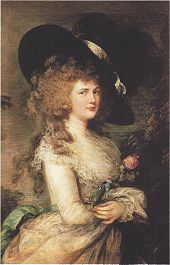
Duchess of Devonshire (1757-1806)
Now I do gloss over much of this, because who wants to read about a lady stepping in shit, or urine running down the gutter? But that doesn't alter the reality, or make the characters depicted by Jane Austen and Georgette Heyer and the like, anything other that pure fiction.

Seriously, telling me to read fiction novels to learn where I'm going wrong, is like telling me to read the DaVinci Code to better understand the Catholic Church. That's not to say that the DaVinci code is completely made up and no facts about the church are real, but it's still an inaccurate portrayal and I'd be much better picking up a few factual books on the history of Catholicism.

And while my books do contain accurate historical detail, I really wouldn't recommend them as a way to learn history, because they just don't go into enough depth to be useful in that regard. I'm writing fiction to entertain, not history textbooks.

I think most of my readers are smart enough to understand that, but a few readers do get awful mad at me for deviating from their picture-perfect vision of times gone by.


*A (far from complete) list of affairs and illegitimate children that I have come across during my research.


James Smithson (1765-1829)
Georgiana Cavendish had an illegitimate son while married, with future Prime Minister, Earl Grey. As for her husband, the Duke of Devonshire, well he moved his mistress into the house and they all lived together, like one big happy family.

Lawrence of Arabia was illegitimate, the result of his father leaving his wife for the family's nanny. Sounds like something you'd read in a tabloid, doesnt it, not 1800s England?

Sir Henry Morton Stanley, writer and explorer, was born to an unmarried 19 year old girl in a small Welsh village.

One of the founding fathers of the USA, Alexander Hamilton, was born in the British West Indies colony, to married French woman Rachel Faucette Buck and Scottish Lord (or Laird) Alexander Hamilton.

James Smithson (of the Smithsonian Insttute) was born to the Duke of Northumberland and widow, Elizabeth Hungerford.


Sarah Bernhardt  (AKA the most famous actress the world has ever known) was born to an unmarried, working class girl, her father was unknown.


Countess of Bessborough (1761-1821)
Born in 1824, playwright Alexandre Dumas, was the illigitimate son of a dressmaker and the author, Alexandre Dumas Sr.

Lady Bessborough had two illegitimate children with, Earl Granville.While she was pregnant with their first illegitimate child, Granville had an affair with Lady Hester Stanhope and later, a Russian princess. Then when he had sewn enough wild oats, he married Lady Bessboroug's niece! Now that's what I call keeping it in the family.

Dorothy Jordan had numerous illegitimate children by many fathers, including the Duke of Clarence.

And finally, William IV had ten, yes TEN illegitimate children with Mrs. Jordan.

So the next time you think of doubting my historical fact, please do your homework first, BEFORE getting shitty with me.

Monday, 21 January 2013

Getting to know Annabelle and Richard

An awful lot more research goes into a book than the reader ever sees. I do try and include some historical knowledge in my books, because I assume most people who read historical fiction, like history.

Even so, an awful lot gets left out so here I will share some details and images about Annabelle and Richards lives that will help you "see" them in a little more detail. Click on any of the images to enlarge.


Wyatt's Coffee Shop

Annabelle runs a coffee house on Cockspur Street, which was at the end of Whitehall. Part of Cockspur Street is still there, but most was demolished when the Charing Cross junction was expanded.

On the right you can see 'West Country Mail at the Gloucester Coffee House, Piccadilly,' by James Pollard. Or in other words, a mail coach leaving from outside a coffee house on Piccadilly, which was just around the corner from Cockspur street. It should give you a little idea of what shops, and coffee houses looked like in Regency times.


This picture is a very rare find indeed. A genuine 1830's cooker that was left untouched since world war 2. This is the kind of thing Annabelle baked in. The grill in the centre houses the fire, there is an oven to either side of the fire and on top, a hob where pots and pans sat.

For more details of a genuine regency/Victorian kitchen, please click here, and discover how this treasure trove of history was discovered.


The Burning of the Houses of Parliment

Fire at Westminster Palace (more images at the end of the post)
In my new book, The Reluctant Duchess, one character is caught up in the fire at the Palace of Westminster. This wasn't just a plot point, Westminster palace did suffer a bad fire. Click any of the images to enlarge.

We all know that Guy Fawkes tried to destroy Parliament but what most people don't know is that, where he failed, two workmen succeeded! No bombs, no explosives, no flammable liquids. All it took these men was  a bunch of sticks. Yes, sticks.

Before reading and writing was common, the Exchequer used tally sticks to keep track of debt. A stick was marked with grooves denoting ho much was owed, and the stick was then split don the middle, the Exchequer keeping half and the debtor keeping the other half. No two tally sticks would fit back together, except the two that had once been the same stick. This stopped people cutting extra grooves into a tally stick, or trying to make another with fewer grooves.